
Is Waterloo Region Running Out of Water?
A growing population, limited groundwater, and tough decisions ahead.
LOCAL
3/1/20263 min read
As World Water Day approaches, we’re remember how much we rely on turning on the tap. But here in Waterloo Region, that reminder feels a little closer to home after the region discovered a capacity issue.
The taps are still running. However, experts warn that the region’s heavy reliance on groundwater may not be sustainable at current growth rates.
Where Does Waterloo’s Water Come From?
Unlike many Ontario cities that rely on large lakes, The Region of Waterloo primarily draws water from groundwater aquifers using more than 100 municipal wells, which provide roughly 75–80% of the local drinking water. The remainder is sourced from the Grand River (Region of Waterloo, n.d.).
Groundwater is considered more quality compared to other sources. But it comes with a disadvantage, a concerning one. Groundwater systems recharge slowly. Unlike surface water from lakes such as Lake Ontario, aquifers depend on rainfall and natural filtration through soil layers, a process that can take years.
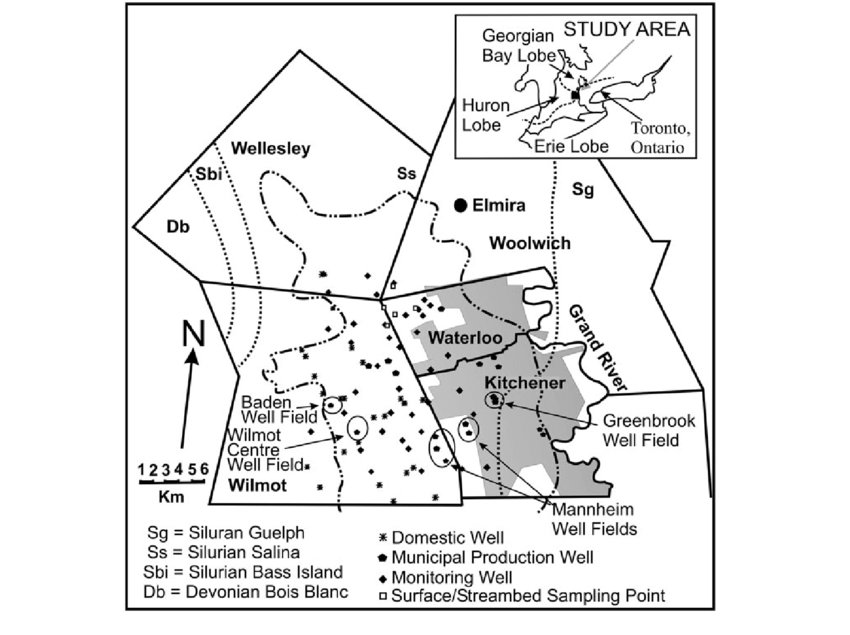
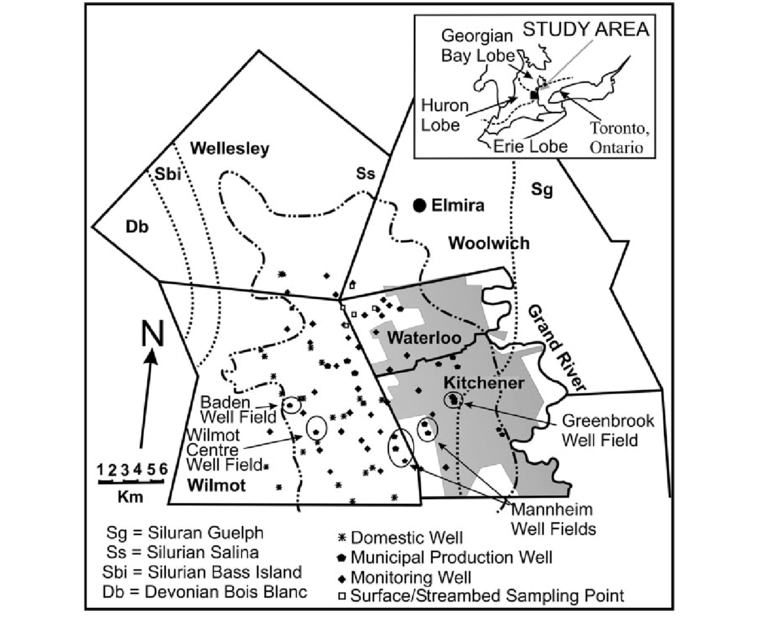
Location of wells in the Waterloo Region in 2014. (University of Waterloo/Lori Labelle)
Waterloo is projecting to reach a population of one million by 2051 (Region of Waterloo, n.d.). This means more people, more development, and eventually more demand on water supplies. When you keep pushing a limited resource that takes years to replenish, aren't we just asking for a water crisis?
A press conference back in December confirmed that these concerns are very real. The Region's latest water strategy review revealed a serious capacity issue in the Mannheim Service Area—which basically means the entire City of Kitchener, Waterloo, and the surrounding townships.
Climate Change Complicates the Picture
Climate variability is another concern. Longer dry periods and unpredictable rainfall patterns affect aquifer recharge rates.
Southern Ontario has already experienced seasonal drought warnings in recent years. If dry cycles become more frequent, groundwater-dependent regions like Waterloo could feel the impact more quickly than lake-fed cities.
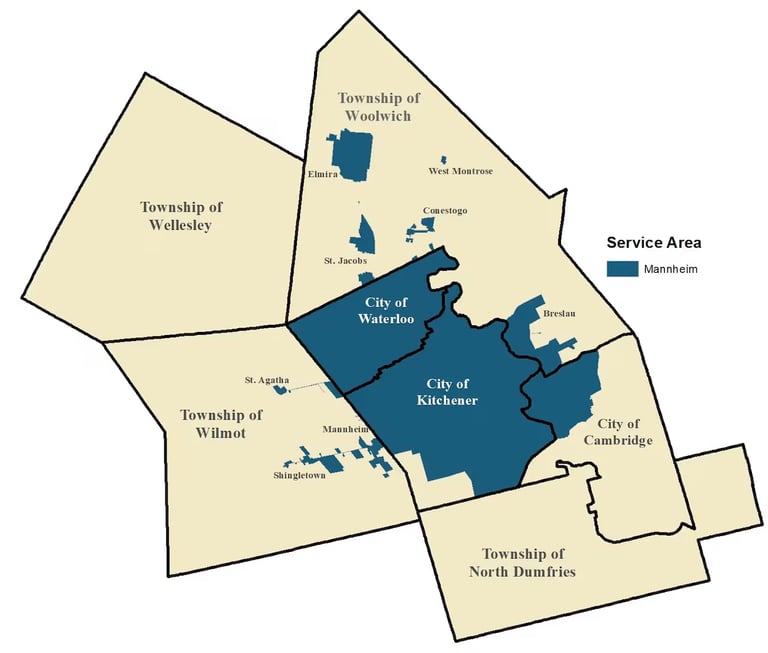
Map of the Mannheim service area. (Region of Waterloo)
Growth vs. Limited Sources
"Right now, there is enough water in Mannheim and residents don’t have to change their consumption habits." Mathieu Goetzke, the acting CAO for the Region of Waterloo, said.
But he warned, the region will have to find other water resources to accommodate future growth.
Residents have mixed reactions. Some support aggressive conservation and infrastructure investment. Others worry that development decisions are moving faster than resource planning.
Potential solutions being discussed include:
Water conservation programs
Infrastructure investment (e.g., new wells, treatment upgrades)
Regional planning that better aligns growth with available water resources
Public Concerns and Policy Debate
Several local development projects are already suspended, including Waterloo Region’s new hospital. Another is the construction of 12 towers at the former Kraus Factory property in north Waterloo, with more than 3,000 residential units.
What Happens Next?
The coming years will bring some tough decisions as we start to remember we only have one earth.
While urging decision-makers to use water more effectively and build better infrastructure, we also need to monitor our daily habits. It is our city, our world, and our water. Let's take good care of it.
Share your thoughts in the comments!
Resources We Used In This Article
Cupe SCFP Ontario. (2025). Bill 60 becomes law: Ontario water at risk as government rushes privatization and deregulation. https://cupe.on.ca/bill-60-becomes-law-ontario-water-at-risk-as-government-rushes-privatization-and-deregulation/
Region of Waterloo. (n.d.) About Water. https://www.regionofwaterloo.ca/en/living-here/about-water.aspx
Region of Waterloo. (n.d.) Population. https://www.regionofwaterloo.ca/en/regional-government/population.aspx
Region of Waterloo. (n.d.) Water Capacity. https://www.regionofwaterloo.ca/en/living-here/water-capacity.aspx
And it’s not just climate pressures adding to the strain. Some political decisions are adding fuel to the fire.
A few months ago, Premier Doug Ford’s government proposed changes to the Clean Water Act that would give the province more control over local drinking water protection plans. Those changes have since passed under Bill 60.
Advocacy groups like Keep Water Public are worried that Bill 60 could make things worse. They say it opens the door to the privatization of Ontario’s water and reduces the oversight needed to protect it (CUPE, 2025).